In a carbon-in-leach (CIL) or carbon-in-pulp (CIP) gold recovery circuit, interstage screens are critical control points. Their function is to retain activated carbon within each adsorption tank while allowing the process slurry to pass through to the next stage. When interstage screens perform correctly, carbon stays in the circuit, gold adsorption continues as designed, and plant throughput is maintained. When they do not, carbon losses accumulate, gold recovery falls, and the cost of the problem often exceeds the cost of replacing the screens that caused it.
Screen Products designs and manufactures precision wedge wire interstage screens for CIL and CIP plants, elution columns, acid wash columns, and carbon safety screen applications. This post covers how interstage screens fit into the gold recovery process, how wedge wire technology works, what the key screen parameters are, and why screen quality has a direct bearing on plant profitability.
Where Interstage Screens Sit in the Gold Recovery Process
Understanding the role of interstage screens starts with understanding the process they are part of.
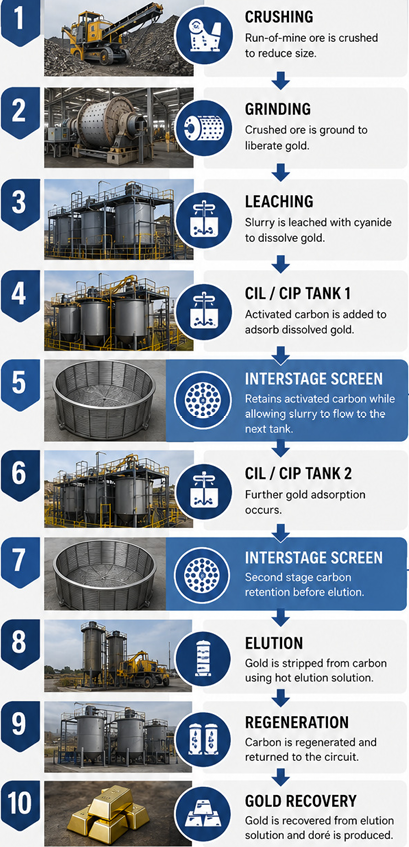
Run-of-mine ore is first crushed and ground to liberate gold particles. The ground ore is then leached with cyanide solution to dissolve the gold into solution. From there, the gold-containing slurry enters a series of adsorption tanks.
In a CIL circuit, activated carbon is added directly to the leaching tanks so that adsorption begins simultaneously with leaching. In a CIP circuit, the ore is leached first and carbon adsorption occurs in a separate series of tanks downstream. In both configurations, activated carbon is the medium that captures dissolved gold from the slurry as it moves through the circuit.
The interstage screen sits at the discharge point of each tank. Slurry flows through the screen apertures into the next tank. The activated carbon, which has a coarser particle size than the slurry, is retained within the tank by the screen. This allows the slurry to progress through the circuit while the loaded carbon accumulates for transfer to elution.
Why Carbon Loss Is a Plant Performance Problem
Activated carbon losses are one of the most common and costly problems in CIL and CIP operations. Plants with underperforming interstage screens regularly experience activated carbon losses, reduced gold adsorption capacity, carbon carry-over into downstream areas of the circuit, screen failures that require unplanned shutdowns, and excessive maintenance frequency.
The financial consequence of carbon loss is direct. Carbon that leaves the circuit carries adsorbed gold with it. Even small, consistent losses compound across the life of the circuit into a material reduction in gold recovered. Beyond the gold loss itself, carbon replacement adds to operating costs, and unplanned maintenance to address screen failures increases downtime.
The key financial principle here is straightforward: the cost of lost carbon, including the gold it carries and the operational disruption it causes, frequently exceeds the cost of specifying and maintaining quality interstage screens in the first place. Carbon loss reduction translates directly to improved recovery. Reduced downtime increases throughput. Longer screen life lowers replacement costs. These are measurable outcomes, not theoretical benefits.
How Wedge Wire Technology Works
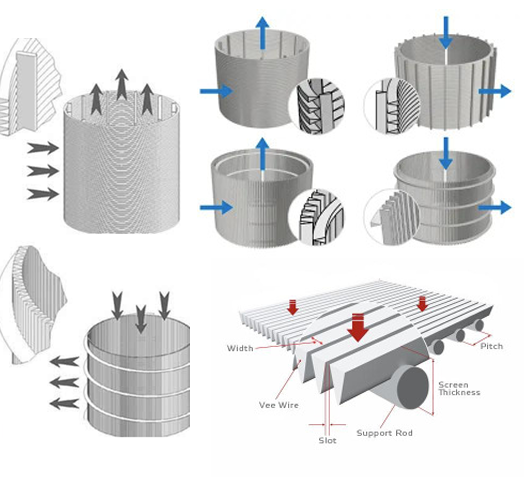
A wedge wire screen is made up of V-profile wire strands welded to support rods at regular intervals. Because the profile is wedge-shaped (wider at the back, narrower at the face), the aperture widens inward, so particles too large to pass through fall away from the surface rather than lodging in the slot, keeping open area consistent over time. The welded construction provides the rigidity needed to withstand continuous agitation inside a CIL or CIP tank.
Screen Parameters
Screen Products manufactures interstage screens to client specification, with slot sizes from 0.25mm to 2.50mm to retain activated carbon while allowing free slurry flow. Material options are SS304, SS316, or Duplex stainless steel, with SS316 and Duplex specified where process chemistry demands higher corrosion resistance. Screens are custom manufactured to match the specific tank configuration, available in two configurations: the MPS Interstage Screen and the MPS(P) Interstage Screen.
Applications Across the Gold Recovery Circuit
Interstage screens are the primary application, but Screen Products’ wedge wire technology is used at several other points in the gold recovery and carbon management process.
Elution Columns: During elution, gold is stripped from loaded carbon using a hot caustic cyanide solution under pressure. Wedge wire screens within the elution column retain the carbon bed while allowing the eluate to flow through. The chemical and temperature environment inside an elution column places specific demands on the screen material and construction, which is why elution column screens are specified separately from interstage screens.
Acid Wash Columns: Before elution, carbon is typically acid-washed to remove calcium carbonate scale and other foulants that reduce adsorption efficiency. Acid wash column screens retain the carbon during this process. The acidic environment requires appropriate material selection.
Carbon Safety Screens: Carbon safety screens are installed at key discharge or transfer points to catch any carbon that passes through the interstage screens. They act as a secondary retention point, limiting the extent of carbon losses when interstage screen performance degrades.
Beyond gold processing, Screen Products’ wedge wire capability extends to DSM screens (sieve bends) for dewatering and classification across mining, minerals, coal preparation, and other industries where liquid-solid separation is required.
Find the Right Screen for Your Circuit
Interstage screens are not a commodity item in a gold recovery circuit. The slot size, material grade, open area, and construction quality of each screen has a direct bearing on carbon retention, gold recovery, and plant availability. Underperforming screens do not just cause maintenance problems. They cause gold loss, and that loss accumulates with every tonne processed.
Screen Products designs and manufactures precision wedge wire interstage screens for CIL plants, CIP plants, elution columns, acid wash columns, and carbon safety screen applications. Screens are custom manufactured to client specifications, with slot sizes from 0.25mm to 2.50mm and materials including SS304, SS316, and Duplex stainless steel.